
Power supply is becoming a defining condition of Australia’s industrial investment. Bell Bay’s operating agreement, Kondinin’s financing and the mobilisation of Project Marinus show how electricity contracts, network delivery and construction productivity influence the businesses that can remain competitive and the new capacity that can be built.
- Bell Bay’s agreement preserves an operating horizon
- Contract duration shapes capital decisions
- Kondinin demonstrates how revenue becomes financeable
- Western Australia has its own delivery context
- Marinus brings the network into the investment equation
- Building the transition is a productivity task
- Resource earnings and energy costs are moving together
- The allocation of risk will determine the next commitments
Australia’s energy investment story spans two different commercial tasks. Existing industrial plants need an operating pathway through a changing power system. New generation and networks need funding, delivery capacity and customers. The success of one influences the other, but their investment decisions are made on different timetables.
Recent agreements in Tasmania and Western Australia make that relationship concrete. Bell Bay Aluminium has secured arrangements supporting continued operation through 2031. Kondinin Wind Farm has reached financial close on its first stage. Project Marinus is moving into construction activity across Tasmania and Victoria. Each development removes a particular uncertainty while leaving other parts of the delivery and operating task ahead.
The larger issue for Australian business is whether the energy system can support productive activity at a cost and level of reliability that justify long-term commitments. A resource endowment or renewable generation potential is a starting advantage. An investable power supply requires that potential to be connected with contracts, networks and a workable allocation of risk.
Bell Bay’s agreement preserves an operating horizon
Rio Tinto announced on 1 October that agreements with the Tasmanian and Australian governments would support Bell Bay Aluminium’s operation through the end of 2031. Hydro Tasmania will continue supplying electricity until 31 December 2031, extending beyond the existing arrangement’s expiry at the end of 2026. The governments will also provide additional support as Tasmania’s energy system evolves.
The smelter produces about 190,000 tonnes of aluminium annually. Rio Tinto reports approximately 550 full-time employees, more than 1,200 indirectly supported jobs and annual purchasing of around $260 million from 180 suppliers. The release does not specify the value of the additional government support or establish the commercial terms of the electricity agreement.
The immediate business significance is the extension of the operating horizon. A plant facing a near-term expiry of a critical input agreement has a different basis for planning from one with several additional years of supply certainty. That difference can affect maintenance, workforce decisions and the confidence of suppliers whose own investments depend on continuing demand.
For northern Tasmania, the agreement concerns an established industrial network as well as one company. Specialist businesses can have capabilities shaped around a large customer. Continuing operation can help preserve that demand, although the agreement alone does not establish new orders, expansion commitments or changes in supplier revenue.
The public support also raises an important economic question: how the cost of maintaining an existing industrial operation relates to the value of its employment, purchasing and productive capability. The company’s published figures describe the scale of activity, but they do not supply a complete assessment of net public benefit. That would require the support terms and a credible comparison with alternative outcomes.
Contract duration shapes capital decisions
The extension to 2031 provides certainty over a defined period. It does not resolve every decision beyond that date. An operator considering an investment with a much longer life must still assess the conditions under which the asset would continue to run after the current arrangement ends.
That is a recurring issue in energy-intensive industry. Electricity can be both a large operating input and a condition of physical production. A competitive short-term price may support current output, while a durable supply arrangement can support a different class of commitment. The two considerations should not be treated as interchangeable.
Suppliers face a related decision at a smaller scale. Hiring and training, buying specialist equipment or expanding a workshop may depend on expectations about a major customer’s future workload. A longer operating pathway can improve the basis for those decisions, but it does not mean every supplier should expand or that every investment will earn an adequate return.
The broader industrial policy issue is continuity during transition. Retaining existing capability may have value when replacing it would require years of investment and training. At the same time, an operating extension is most useful when it creates time to make the next set of commercial decisions. A bridge to a future arrangement still needs a destination that can be funded and sustained.
Kondinin demonstrates how revenue becomes financeable
Foresight announced financial close on 30 September for the 130-megawatt first stage of Kondinin Wind Farm in Western Australia’s Wheatbelt, supported by $430 million in debt financing. The lenders are ANZ, Commonwealth Bank, Deutsche Bank, HSBC and Westpac. Foresight has also acquired Shell Energy’s half interest, taking full ownership of the broader 370-megawatt Kondinin Energy Project.
Stage 1 has a seven-year agreement with Synergy for all the renewable energy it generates and a 15-year Capacity Investment Scheme agreement providing revenue support. Vestas will deliver 21 turbines. These arrangements concern the financed 130-megawatt stage; they should not be reported as financial close or construction of all 370 megawatts.
The commercial structure illustrates how a development moves beyond a statement of generating potential. A project’s lenders need a basis for assessing future receipts and its capacity to meet debt obligations. Contracted purchasing and revenue support can reduce particular uncertainties, allowing financing to be committed before the asset begins producing electricity.
They do not remove construction and operating risk. The asset must still be delivered, connected and run. Its performance must meet the obligations and expectations attached to the financing and supply arrangements. Financial close is therefore a substantial milestone because it supports execution, rather than because it guarantees every subsequent outcome.
The difference between the seven-year purchase agreement and 15-year revenue support also matters. Those instruments have different roles and durations. Without the complete contract terms, their combined effect on every price or volume scenario cannot be quantified. The published structure nevertheless shows that several commercial arrangements can work together to support a single investment decision.
Western Australia has its own delivery context
Kondinin’s progress should be assessed within Western Australia’s electricity market. Its investment cannot simply be added to an east-coast network project and treated as one interconnected supply solution. Geography and network structure determine where generating capacity can serve demand and which transmission arrangements it requires.
That distinction is important for industrial location. A business buying electricity for a site needs to understand the market serving that site, the connection available and the terms under which its load can be supplied. National totals for announced renewable capacity provide useful context, but do not establish the power available to an individual operation.
A staged development can also offer a practical way to align delivery with commercial readiness. The first investment can proceed on its own financing and contracted revenue while later capacity remains subject to further decisions. This can create a clearer boundary around the risks being undertaken, although the economics still depend on how shared infrastructure and future options are managed.
For regional suppliers, the transition into construction changes the opportunity from development support towards delivery. Civil work, transport and site services may become more immediate, while long-term operating demand comes later. The relevant commitments need to be distinguished from the potential scale of the broader project.
Marinus brings the network into the investment equation
Project Marinus held its sod-turning ceremony in north-west Tasmania on 2 October, following financial close and successive approvals. Marinus Link and TasNetworks’ North West Transmission Developments are increasing construction activity across Tasmania and Victoria. The project reported 119 engaged businesses and suppliers, including 59 from northern and north-western Tasmania.
TasNetworks’ first transmission stage covers 130 kilometres and is due in service by 2030. Work has begun between Sheffield and Burnie. Marinus Link’s cable and converter manufacturing and construction activity will ramp up into the following year, including converter stations and works along the underground cable route in Gippsland.
The strategic role of an interconnector differs from that of a generating plant. It creates an additional pathway for electricity to move between markets. Its value depends on the resources, demand and operating conditions on either side, along with the supporting networks that make the connection usable.
For industrial planning, the distinction between construction progress and available capacity remains essential. A project moving into delivery can improve confidence about the future network, but it cannot be treated as though it is already providing service. Businesses making near-term operating commitments still need arrangements that work with the system available today.
There is also a sequencing challenge across the wider programme. Cable manufacture, converter works, land-based transmission and connection activities must come together to create a functioning asset. Progress in one package is important, but the complete service depends on all critical components. This is why construction milestones should be reported alongside their role in the overall delivery schedule.
Building the transition is a productivity task
ARENA’s $25 million support for Equans Solar & Storage’s Lightspeed project addresses another part of the economics: the cost of delivering and maintaining generating assets. Announced in September, the three-year programme will trial up to ten technologies across civil, mechanical and electrical work, operations and maintenance, and digital coordination. Its initial trial will use an autonomous inspection robot.
The technologies are being tested for potential benefits. The announcement does not establish a realised reduction in construction costs or electricity prices. The practical value will depend on demonstrated performance in real operating environments and on whether successful methods can be adopted beyond the trial sites.
That focus matters because cheaper components do not automatically produce a proportionate reduction in the cost of a completed asset. Installation, site preparation, logistics, coordination and maintenance also influence the overall result. A technology that performs well in isolation may need changes to a contractor’s workflow before its benefits can be realised.
The most useful productivity improvement is consequently one that survives the full delivery process. Reduced manual effort can create savings, but extra supervision, integration or rework can offset them. A credible trial needs to establish the conditions under which the approach works and the costs required to use it safely and reliably.
For Australian industry, a repeatable improvement can have significance beyond one project. A supplier able to apply a proven method across several sites can build capability and improve utilisation of scarce people or equipment. That is different from assuming that the announcement of an innovation programme has already increased national delivery capacity.
Resource earnings and energy costs are moving together
The September Resources and Energy Quarterly forecasts export earnings of about $422 billion in 2026–27, compared with $403 billion in 2025–26, before easing to $391 billion in 2027–28. It identifies stronger near-term energy prices alongside risks from higher diesel costs for mining and transport. Its central scenario assumes Middle East export flows gradually recover.
Those forecasts show why a higher export total does not translate directly into stronger conditions for every Australian business. A producer benefiting from commodity prices may still face more expensive fuel, freight or equipment. A manufacturer using energy and transported materials can experience the cost effect without receiving the export-price benefit.
The resource outlook and electricity investment therefore need to be considered through the margins of individual activities. Export revenue, industrial operating cost and project construction cost are different measures. A stronger aggregate result can coexist with a difficult investment decision for a particular processing plant or supplier.
The baseline also remains conditional. A longer disruption to international energy flows would alter price and demand conditions. It could support some export receipts while increasing costs elsewhere. Long-term capital decisions need to accommodate that uncertainty rather than rely on a single current price environment persisting through the life of an asset.
The allocation of risk will determine the next commitments
Bell Bay, Kondinin and Marinus demonstrate three ways in which uncertainty can be reduced: an operating agreement, a financeable revenue structure and a network moving towards delivery. Their common feature is that institutions and counterparties have made commitments with a defined purpose. Each arrangement assigns some risks to parties able or willing to carry them.
The remaining risks still need to be funded. Government support uses public resources; a power purchaser takes on contractual obligations; lenders assess their exposure; and an operator remains responsible for the performance of its asset. An agreement that enables investment is economically useful, but its value cannot be assessed solely through the fact that it has been signed.
There are trade-offs between preserving existing capacity and creating new supply, between early certainty and flexibility, and between allocating costs to users and spreading them more widely. These choices become more visible when energy policy is connected to industrial decisions. They influence which projects proceed, where businesses locate and how much risk remains on their balance sheets.
The next milestones will be practical ones: construction advancing at Kondinin, the interlocking packages of Project Marinus reaching delivery stages, and Bell Bay operating under its extended arrangements. Evidence from the Lightspeed trials will provide a separate test of whether innovation can reduce the resources needed to build and maintain the transition.
Australia’s energy advantage will become an industrial advantage when businesses can use it under dependable commercial conditions. The recent developments provide progress on that task, with different timescales and different obligations. Their lasting significance will be measured in operating plants, connected generation and networks, and investment that remains competitive after the announcements have passed.
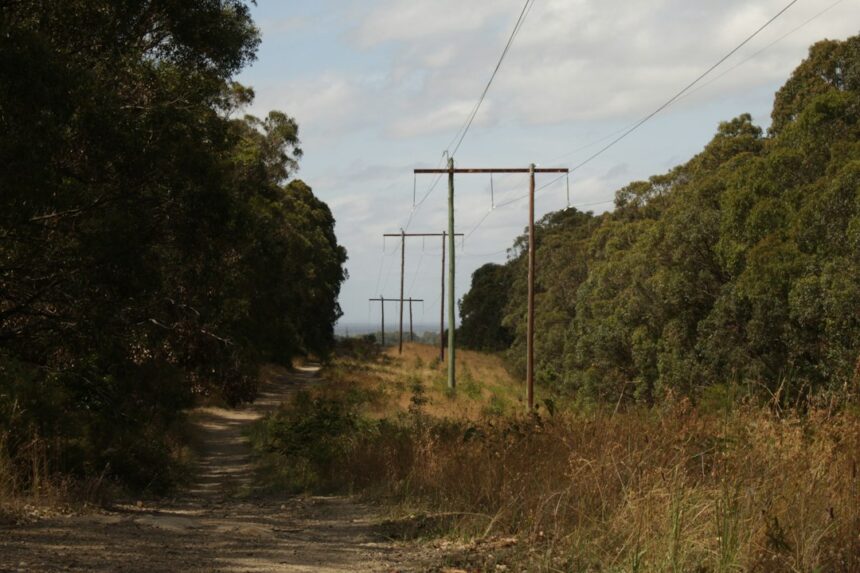
Photography: hayley / Unsplash; illustrative electricity transmission photograph, not Project Marinus.
Sources: Rio Tinto — Bell Bay operating agreement; Foresight — Kondinin financial close; Marinus Link — Construction mobilisation; ARENA — Lightspeed innovation programme; Department of Industry — September Resources and Energy Quarterly.