
Myriota: the Adelaide satellite-IoT company connecting industrial assets beyond the last mobile tower
Myriota began with a telecommunications problem that is particularly visible in Australia: vast areas where valuable equipment, water systems, livestock and infrastructure sit beyond reliable terrestrial coverage.
Founded in Adelaide in 2015 as a University of South Australia spin-out, the venture commercialised research led by co-founders Dr Alex Grant and Dr David Haley. Their work had already produced a world-first transmission of Internet of Things data directly to a nanosatellite in 2013. The company set out to turn that technical achievement into connectivity that could operate at low cost and on very little power.
More than a decade later, Myriota is building a broader industrial platform around satellites, devices and software. Its current significance is illustrated by a partnership announced on 20 November with fleet-management provider Cartrack. The agreement brings Myriota’s AssetHawk tracker to a commercial network serving more than 125,000 customers in over 20 countries.
From university research to an industrial network
Grant initially led Myriota as chief executive while Haley became chief technology officer. In 2022, Grant moved to a non-executive director role and Ben Cade, who had joined as chief commercial officer, became CEO. Haley remains CTO and co-founder, preserving the company’s technical continuity as Cade drives international commercial expansion.
The founding insight was that conventional satellite communications were too expensive and power-hungry for millions of small industrial sensors. Myriota designed secure, narrowband communications that could send compact packets of data directly to orbit, allowing a remote device to operate for years without grid power or a nearby cellular network.
That architecture addresses practical tasks rather than consumer broadband. Agriculture businesses can monitor tanks, troughs or pumps. Utilities can receive readings from dispersed assets. Mining and construction operators can locate equipment. Logistics companies can track unpowered trailers and containers that move in and out of mobile coverage.
The company says its intellectual-property portfolio now exceeds 100 granted patents. Its network blends sovereign satellite assets with capacity from trusted space-service partners, while its products include modules for equipment makers, cloud management tools and finished devices for faster deployment.
AssetHawk widens the buyer proposition
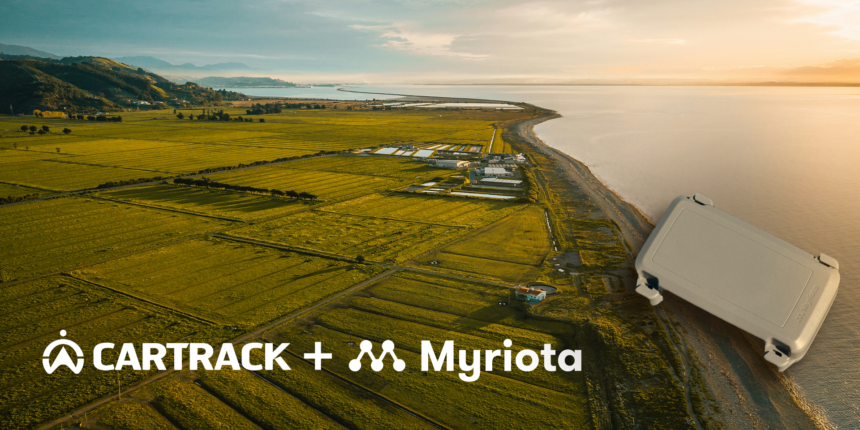
AssetHawk is a rugged battery-powered tracker designed for fixed and moving assets. It combines cellular standards used across more than 190 countries with Myriota’s HyperPulse satellite network, automatically changing route when terrestrial coverage disappears.
The device also connects to nearby Bluetooth Low Energy sensors. That allows one tracker to become a local data hub for conditions such as temperature, movement or environmental readings rather than simply transmitting a location.
Myriota says the enclosure is rated IP68 and the battery can last up to 10 years, depending on use. Those attributes are commercially important because the cost of sending a technician to replace a battery on a remote asset can exceed the cost of the communications service.
The Cartrack partnership is a useful test of the model. Cartrack already provides fleet management, visualisation and operational data to a large installed customer base. Adding AssetHawk lets it extend visibility to generators, trailers, non-powered equipment and other assets operating outside dependable cellular coverage without asking customers to adopt a separate tracking environment.
Two networks, one service
In July, Myriota added cellular connectivity to HyperPulse and AssetHawk. The change moved the proposition beyond satellite-only applications into assets that spend part of their life in cities or along transport corridors and part in remote areas.
HyperPulse is built to the 3GPP Release 17 non-terrestrial-network standard and uses leased L-band capacity from Viasat alongside Myriota’s own optimisation layer. The company markets hybrid plans from less than US$1 per device a month, although actual customer economics depend on data requirements and deployment scale.
This standards-based approach expands the partner ecosystem because device and chip suppliers do not need to rely only on proprietary hardware. It also increases competitive pressure. Large mobile operators, satellite constellations and specialist IoT networks are all pursuing the same gap between terrestrial coverage and remote operations.
Capital has stayed tied to Australian capability
Myriota’s last fully company-disclosed funding package was A$50 million in December 2024, led by a A$25 million equity investment from the National Reconstruction Fund Corporation alongside Main Sequence and other investors. The company said the capital would expand its Adelaide advanced-manufacturing base, platform and workforce.
That investment followed earlier venture backing from organisations including Boeing HorizonX, Singtel Innov8, In-Q-Tel, Hostplus and Australian technology investors. It also placed public capital behind a business considered relevant to advanced manufacturing, regional productivity and sovereign communications capability.
Myriota has continued to prepare for scale. In August it appointed Richard Leon as chief financial officer after his involvement in Altium’s A$9.1 billion sale to Renesas. The appointment linked the next phase to experience in global growth, capital markets and public-company transactions.
Commercial expansion has also come through a mixture of direct network development and partnerships. Myriota launched eight satellites in January, expanded its constellation again in July and integrated AssetHawk with the RedGPS tracking platform for Latin American customers. In June it brought tank-monitoring specialist One-Tank into the group, adding application experience and an installed industrial use case to the underlying communications technology.
This partner-led route reduces the need to sell every end customer directly, but it raises a different requirement: Myriota must make its hardware, software and service levels consistent enough for other companies to put their own customer relationships behind the platform. Distribution quality and integration support will therefore be as important to scale as satellite coverage.
The next challenge is repeatable deployment
The company’s opportunity sits at the intersection of satellite infrastructure, industrial digitisation and physical-world data for artificial intelligence. Its constraint is execution across all three.
Industrial buyers demand dependable hardware, long service lives, security and integration with existing systems. Sales can take time, and a partnership is not the same as fleet-wide deployment. Myriota must also manage satellite capacity, manufacturing, spectrum permissions and customer support across many jurisdictions while keeping connectivity affordable.
The Cartrack agreement strengthens the route to market because it places Myriota technology inside an established operational platform. The evidence to watch is how quickly that channel converts into deployed devices and recurring network traffic.
Myriota’s Australian identity remains central rather than incidental. The underlying communications research began in Adelaide, its technical leadership and manufacturing capability remain there, and its product is shaped by industries that operate across Australia’s remote geography. The scale opportunity is global, but the venture’s competitive case was built around solving a distinctly Australian infrastructure problem.
Photo: Myriota AssetHawk satellite-IoT tracker in a remote Australian landscape. Official Myriota partnership image, used for editorial identification.
Sources: Myriota company and leadership information; Myriota founding and Series A history; Cartrack partnership, 20 November 2026; HyperPulse hybrid-network launch; AssetHawk product information; National Reconstruction Fund investment; CFO appointment.