
Morse Micro is turning a decade of Australian wireless-chip engineering into a bid to make Wi-Fi HaLow the connectivity layer for industrial systems, farms, smart infrastructure and edge AI.
The Sydney company’s latest proof point is commercial rather than theoretical. On 5 November, networking manufacturer MikroTik launched its first outdoor Wi-Fi HaLow gateway using Morse Micro’s MM6108 system-on-chip. Two days earlier, Morse Micro joined the EDGE AI FOUNDATION as a strategic partner, placing its technology in a developer community focused on running artificial intelligence closer to cameras, sensors and machinery.
Those moves show the venture’s central challenge and opportunity. Morse Micro has developed specialised silicon and brought products into mass production; the next stage depends on convincing equipment makers and enterprise buyers to build a broad ecosystem around a relatively new Wi-Fi standard.
Reinventing Wi-Fi from Sydney
Former Broadcom engineers Michael De Nil and Andrew Terry founded Morse Micro in Sydney in 2016. De Nil is chief executive and Terry is chief technology officer. Both had worked on Wi-Fi chips used in smartphones and saw an opening created by IEEE 802.11ah, the sub-1 GHz standard marketed as Wi-Fi HaLow.
Conventional Wi-Fi delivers high data rates over relatively short distances. HaLow trades peak speed for longer range, better penetration through walls and lower power use. It keeps standard IP networking and WPA3 security, avoiding the separate translation gateways often required by proprietary low-power networks.
That combination is aimed at devices spread across sites where cabling, subscriptions or dense access-point networks are expensive: industrial yards, mines, farms, campuses, water systems and smart-city infrastructure. Morse Micro says HaLow can provide up to ten times conventional Wi-Fi’s range and cover up to 100 times the area. Those are company performance claims and will vary with spectrum rules, obstacles, antenna design and deployment conditions.
From first chip to product shelf
Morse Micro’s first-generation MM6108 is in volume production and has been incorporated into modules, cameras, gateways and development products. Its second-generation MM8108 increases data rates and power efficiency in a smaller footprint. The company also sells the HaLowLink 2 router and extender as a way for developers and customers to evaluate the technology without designing a board from scratch.
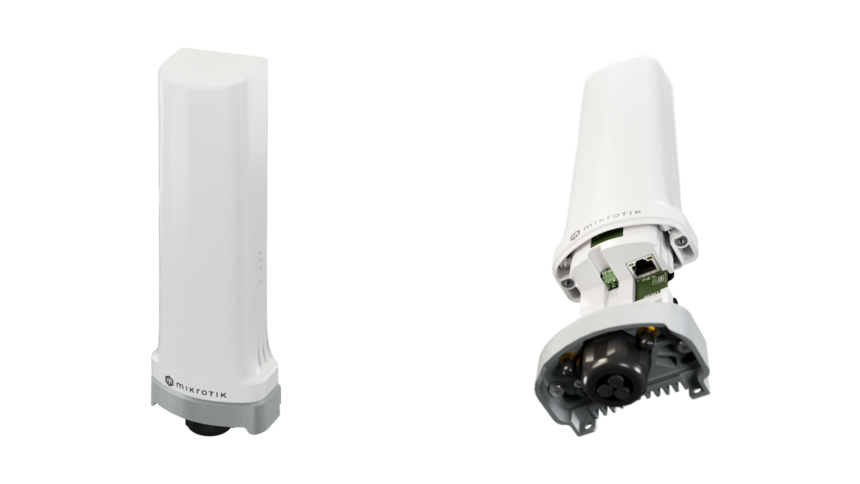
The MikroTik KNOT Gateway HL9 is a useful marker because it is a finished, purchasable product from an established networking supplier, not a laboratory demonstration. The IP66-rated outdoor gateway combines Wi-Fi HaLow with LTE backhaul, GPS, Ethernet, Bluetooth and conventional 2.4 GHz Wi-Fi. It is designed for telemetry, asset tracking, agriculture and municipal sensing where wired backhaul is absent or impractical.
Other end products listed by Morse Micro include solar security cameras, industrial access points, people-counting sensors and developer gateways. Distribution through DigiKey and design partnerships with firms including Gateworks are intended to shorten the path from chip evaluation to certified product.
Patient capital for a hard-technology scale-up
Semiconductor ventures require substantial funding before volume revenue is assured. Morse Micro raised A$88 million in a Series C round announced in September 2025, led by MegaChips. The National Reconstruction Fund Corporation invested A$35 million, alongside existing and institutional investors, taking disclosed total funding at the time above A$290 million.
The investor group also includes Australian venture firms Blackbird, Main Sequence and Uniseed, superannuation-backed capital and experienced semiconductor investors. That mix gives Morse Micro access to both patient domestic funding and industry networks, but it also increases expectations that capital will translate into manufacturing scale, export sales and defensible intellectual property.
The NRFC described Morse Micro as Australia’s largest semiconductor manufacturer and said its investment would support next-generation product development, growth and skilled jobs in Sydney and Picton. Morse Micro now reports more than 200 employees and more than 90 patents on its investor page, while operating offices across the United States, Taiwan, China, India, Japan and the United Kingdom.
It remains a fabless semiconductor company: Morse Micro designs the chips and software but relies on external foundries and assembly-and-test partners. That model reduces the capital required to own a fabrication plant, while leaving the company exposed to global manufacturing capacity, lead times and geopolitical supply-chain risk.
The adoption contest
HaLow sits between several established connectivity choices. Conventional Wi-Fi has an enormous installed base. Cellular IoT provides wide-area coverage but can add subscription and carrier dependencies. LoRaWAN and other low-power wide-area networks serve low-data-rate sensing. Private 5G, Bluetooth and proprietary mesh systems compete in different performance and cost bands.
Morse Micro’s case rests on offering longer-range, higher-throughput connectivity with standard Wi-Fi tooling and no per-device carrier plan. The technical proposition is strongest where buyers need video, images or frequent firmware updates across a large site, but do not need laptop-class peak speeds.
The harder problem is coordination. Chip suppliers need device makers; device makers need gateways and certified modules; enterprise buyers need proven support, security and interoperability. A superior radio alone does not create a market. Morse Micro’s design-partner program, distribution deals and visible end products are therefore as important as benchmark records.
Regulatory differences across countries also complicate scale because sub-1 GHz spectrum allocations and power limits are not identical. Product certification, software maturity and a resilient outsourced supply chain will determine whether the company can convert development kits and partnerships into sustained high-volume orders.
An Australian platform with global ambition
Morse Micro’s Australian significance extends beyond venture funding. It concentrates radio-frequency, integrated-circuit and embedded-software capability in a country that imports most semiconductors. Its Picton production and validation activity gives the company a local operating base while commercial expansion occurs globally.
The next scale test will be repeat design wins that move from announced modules and gateways into deployed fleets. MikroTik’s product launch and the EDGE AI FOUNDATION partnership broaden the funnel, but revenue quality will depend on adoption by equipment manufacturers and operators in real sites.
If HaLow becomes a standard layer for distributed intelligent devices, Morse Micro will have helped create the category from Sydney. If adoption remains fragmented, it will face the familiar hard-tech risk of strong engineering outrunning market timing. The venture has crossed the first barrier by shipping silicon; its next chapter is about making that silicon routine infrastructure.
Featured image: MikroTik KNOT Gateway HL9 using Morse Micro silicon. Image supplied by Morse Micro/MikroTik.
Sources: Morse Micro company history and leadership; National Reconstruction Fund Corporation investment profile; Morse Micro Series C announcement; MikroTik product announcement; EDGE AI FOUNDATION partnership announcement; Morse Micro end-product catalogue.