
Australia’s hospital investment programme is creating long-lived economic anchors in metropolitan growth corridors and regional centres. The next test is to connect new clinical buildings with workforce accommodation, training, logistics and operating capacity, so that construction spending becomes a durable expansion of services.
- A national service industry behind the construction pipeline
- Nepean moves from capital delivery to operational readiness
- Grafton links clinical expansion with a broader precinct
- Accommodation becomes part of service capacity
- Fairfield shows why project stages must remain separate
- Frankston’s second stage concentrates on the operating backbone
- Workforce strategy connects buildings with professional capacity
- The recurring economy matters as much as the capital spend
- What the next milestones will reveal
The most visible part of a hospital redevelopment is usually its new building. The larger economic story begins with the system required to use it: the people who staff it, the suppliers who keep it functioning, the services that move into it and the community connections that make it accessible. Those dependencies influence the value of the investment long after the construction contract is complete.
Recent developments at Nepean, Grafton, Fairfield and Frankston show different parts of that process. One project is preparing for patients after construction completion, another is beginning main works while maintaining existing services, and others are combining clinical expansion with supporting facilities. Taken together, they offer a broader view of health investment than a tally of new beds or capital budgets.
The commercial proposition is that a hospital can act as a stable regional institution, supporting employment, purchasing and specialist capability. Realising that proposition requires a functioning service, rather than a completed structure alone. Capital delivery and operational delivery have different milestones, different risks and different funding demands. Their relationship determines when an investment begins producing the benefits expected of it.
A national service industry behind the construction pipeline
The Australian Institute of Health and Welfare reports 703 public hospitals and about 68,200 available beds in 2024–25. Public hospital services employed approximately 486,000 full-time-equivalent staff, including around 202,000 nurses and 62,100 salaried medical officers. Available public beds per 1,000 people changed only slightly, from 2.52 in 2023–24 to 2.51 in 2024–25.
Those figures establish the scale of the operating industry behind the building programme. They do not measure the readiness of any particular redevelopment or establish that a new facility will resolve local service pressures. A national bed count also cannot describe differences in clinical capability, staffing or access between communities.
For the business economy, hospital expansion has two distinct effects. Construction creates a time-limited stream of design, building and fit-out work. The operating service creates recurring demand across clinical and non-clinical activities. The second stream can endure for decades, but its size and composition depend on the services commissioned and the way the hospital is managed.
That distinction changes how local firms assess the opportunity. A supplier providing a construction package may have a short, intensive contract. A maintenance, catering or logistics provider may face a longer relationship with different performance requirements. The value of the hospital as an economic anchor rests partly on the ability to sustain those relationships while maintaining reliable care.
Nepean moves from capital delivery to operational readiness
Health Infrastructure announced construction completion of Nepean Hospital’s seven-storey Stage 2 building on 6 October. The facility forms part of a redevelopment worth more than $1 billion and is expected to welcome patients from late 2026. Its planned services include intensive care, paediatrics, imaging and renal dialysis, alongside training, kitchen and clinical support facilities.
The local health district is now undertaking commissioning, including equipment installation and testing, staff orientation and preparations for staged departmental relocations. The building’s completion therefore marks the beginning of another delivery phase. It should not be reported as though all of the new services are already operating.
The significance of commissioning extends beyond the opening date. A hospital brings together equipment, information, building systems and clinical workflows. A service can be ready in one respect and dependent on another in practice. Moving a department requires more than transferring furniture; the operating team must be able to work safely and consistently in a different environment.
For contractors and suppliers, this transition changes the nature of demand. The emphasis moves from constructing the asset towards demonstrating that its systems work together, resolving outstanding issues and supporting the operator. The economic benefit becomes more tangible as spaces enter service, but the pace of that transition needs to follow operational readiness.
The Nepean example also illustrates why a headline redevelopment value should be treated carefully. A multi-stage programme can include different buildings, scopes and years of spending. Its total is not the price of the latest structure alone. Accurate reporting allows businesses to distinguish a new procurement opportunity from the completion of work already funded and contracted.
Grafton links clinical expansion with a broader precinct
Main works began in September on the $283.8 million Grafton Base Hospital redevelopment, with construction expected to finish in 2029. Richard Crookes Constructions is delivering the main works after enabling works by Woollam Constructions. The new acute services building will accommodate functions including emergency care, surgery, imaging, inpatient care and maternity services.
Existing hospital services will continue through construction. Refurbished buildings in the former Grafton Gaol precinct have also created administration and workforce development facilities. These enabling moves help free space for clinical expansion while giving the workforce a supporting base outside the main hospital works.
The business relevance lies in the relationship between the parts. A regional hospital is difficult to redevelop as though it were an empty site. Its service role continues while construction changes access, circulation and the physical environment. The programme must therefore create room to build without withdrawing the functions on which the community already depends.
That is an interface problem as well as a construction problem. Deliveries, patients, staff and contractors may need to use adjoining areas for different purposes. Work that is efficient on an isolated site can require a different sequence in an operating health campus. The additional coordination has value because it protects continuity during the investment period.
A workforce development precinct adds another dimension. Training and administration are supporting functions, but they are part of the service’s capacity to operate and adapt. Giving them appropriate space can support the clinical programme without using the most valuable clinical areas for every non-clinical activity. It also makes the redevelopment an investment in the wider campus rather than a single replacement building.
Accommodation becomes part of service capacity
Grafton’s workforce accommodation project provides a direct link between property and health operations. NSW Health appointed Bennett Constructions in September to deliver 36 self-contained, one-bedroom units opposite the hospital, refurbishing buildings in the former gaol’s minimum-security wing. Completion of this stage is expected by mid-2027.
The work sits within a $34.2 million Northern NSW accommodation investment and a $200.1 million statewide programme covering 20 projects. The site has capacity for another 36 units in a future stage, but that potential should not be confused with the contracted first stage. The announced purpose is to help attract and retain health workers.
The broader implication is that recruitment depends partly on the practicality of living near the service. A clinical role can be available while suitable accommodation remains difficult to arrange. Dedicated housing can reduce that obstacle, particularly when a worker needs to relocate, but its effect still depends on who can access it, for how long and on what terms.
The type of accommodation also matters. One-bedroom units can suit some workers and assignments, while households with children or other needs may require a different housing solution. The project should therefore be understood as one contribution to workforce availability, rather than proof that every recruitment constraint has been removed.
For a regional economy, that distinction keeps the investment case grounded. Reusing an existing site can provide accommodation and release hospital space for other purposes. Longer-term retention also requires a professional and personal environment in which people can remain. Housing, training, career pathways and reliable services can reinforce one another, but none substitutes entirely for the rest.
Fairfield shows why project stages must remain separate
Fairfield Hospital’s $630 million redevelopment combines a $550 million NSW commitment with an $80 million Commonwealth contribution for emergency department expansion. Planning documents for the proposed clinical services building went on exhibition in September, with submissions due on 23 October. The clinical building remains subject to approval.
A separate multi-storey car park is already under construction, with more than 450 spaces and completion expected in late 2027. The two activities belong to the same redevelopment but sit at different stages. Progress on the car park does not establish that construction of the proposed clinical building has been approved or begun.
This distinction is commercially material. Suppliers assessing a development need to know whether a package is proposed, funded, approved, tendered or contracted. Each stage carries a different degree of certainty and a different opportunity to participate. Combining them into a single statement that a project is “under way” can obscure both the remaining decisions and the work already committed.
Supporting infrastructure also affects how a campus functions. Parking and pedestrian connections can influence access for staff and visitors, while construction arrangements can affect the daily use of existing facilities. These works may attract less attention than a clinical tower, but they form part of the operating environment that a larger hospital requires.
The opportunity is to assess campus investment as a sequence of connected decisions. Early enabling works can make later expansion possible. Their usefulness should be measured against that role, rather than assumed simply because they occur on the same site. Clear sequencing gives the operator and its suppliers a better basis for preparing for the next phase.
Frankston’s second stage concentrates on the operating backbone
At Frankston, the Victorian Health Building Authority’s September update describes Stage 2 works following the opening earlier in 2026 of a new 12-storey tower at Peninsula University Hospital. The works include refurbishment of the existing building, theatre support and logistics areas, office and staff facilities, a larger commercial kitchen and expanded loading docks.
The programme also includes a refurbished connection between the existing building and tower, with community and childcare facilities planned on the site. The emphasis demonstrates how further work can remain necessary after a major clinical building opens. The campus needs supporting spaces that allow its expanded functions to operate together.
Loading docks and kitchens are part of that operating backbone. Their performance influences the flow of goods through a site and the ability to provide essential support services. They do not have the same public visibility as new clinical rooms, but poorly matched supporting capacity can constrain the use of a larger facility.
Staff spaces have a different, related role. An employer asking people to work across demanding rosters needs an environment that supports the work. Appropriate amenities do not establish a measurable improvement in retention by themselves, but they form part of the conditions under which a service competes for and sustains its workforce.
Frankston also provides a useful follow-up to the usual opening narrative. The first patient milestone is important, yet it can sit within a longer transformation of the campus. Continuing investment may address the relationship between old and new facilities, rather than representing a failure of the earlier stage. The relevant question is what each successive package adds to service capability.
Workforce strategy connects buildings with professional capacity
The Australian Government’s National Nursing Workforce Strategy, published in August 2026, focuses on attraction, recruitment and retention, alongside innovative multidisciplinary practice and leadership. It supplies a national framework for workforce development, rather than a guarantee of staffing for individual hospital expansions.
Its relevance to capital investment is practical. A new clinical facility requires a workforce with the appropriate skills and organisation. Those requirements need to be considered while the building programme advances, because professional development and recruitment cannot always be compressed into the final weeks before opening.
Training facilities can support that preparation, but physical space is only one element. Supervision, experienced colleagues and protected opportunities to learn determine how useful that space becomes. The link between a teaching environment and a stronger workforce depends on an operating programme behind it.
Regional services face an additional coordination task when they seek to attract people from elsewhere. An employment offer, an accommodation arrangement and a realistic commencement date need to fit together. If one changes, the others may need adjustment. Treating these as connected preparations can reduce the risk that a ready building waits for people or that recruited staff arrive before facilities are ready.
The recurring economy matters as much as the capital spend
For local businesses, the most durable opportunity in hospital investment may emerge after the construction workforce leaves. An operating campus needs maintenance, consumables, food, cleaning, information services and logistics, in addition to its clinical supply requirements. These functions create a different commercial relationship from a one-off building contract.
Participation is not automatic for nearby firms. Health services require continuity and dependable performance, and procurement arrangements may group requirements across facilities. A local business therefore needs to understand the actual contracting route and service specification. Geographic proximity can assist responsiveness, but does not replace qualification or a competitive offer.
There are also limits to the wider economic claims that can responsibly be made. A new facility may support a region’s attractiveness to employers and households, but a capital announcement does not establish how much private investment it will generate. Such effects depend on service availability, the surrounding labour market and other infrastructure. They are potential benefits requiring evidence over time.
The same discipline applies to savings. Better facilities can improve workflows, but an expanded service may also increase recurring expenditure. A larger asset requires staffing, maintenance and replacement of equipment. Its economic value should be assessed through the services it can reliably provide, alongside the cost of sustaining them.
What the next milestones will reveal
The coming stages provide distinct tests across the four locations. Nepean’s commissioning and staged patient openings will show how completed construction becomes operational capacity. Grafton’s main works and accommodation programme will show how a regional campus combines clinical expansion with workforce support. Fairfield’s planning decision will determine the next step for its proposed clinical building, while Frankston continues integrating its supporting facilities.
These are different investments at different points in their delivery cycles. Their common lesson is that the performance of a hospital programme depends on connections: between capital and recurrent funding, buildings and people, clinical space and logistics, and the campus and the community it serves.
Australia’s hospital pipeline can create substantial business activity and long-lived regional value. The clearest measure of success will be the services that operate after construction, the workforce able to deliver them and the supporting economy that keeps them functioning. That is where a health building becomes a health investment.
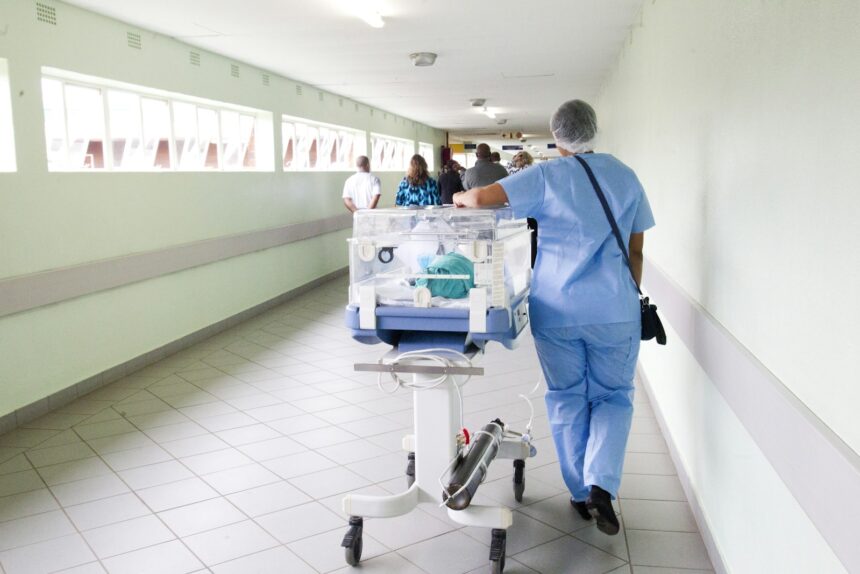
Photography: Hush Naidoo Jade Photography / Unsplash; illustrative healthcare photograph, not a named project.
Sources: AIHW — Hospital resources; Health Infrastructure — Nepean Stage 2 construction completion; Health Infrastructure — Grafton main works; NSW Health — Grafton workforce accommodation; NSW Health — Fairfield redevelopment; VHBA — Frankston Stage 2; Department of Health — National Nursing Workforce Strategy.