

The Rockhampton Ring Road has moved deeper into its major-structures phase, with piling starting on the new Fitzroy River crossing and the final girders installed on the Capricorn Highway connector bridge.
The Federal and Queensland governments marked the milestones on 18 September as work progressed across several fronts on the 14.7-kilometre western link of the Bruce Highway.
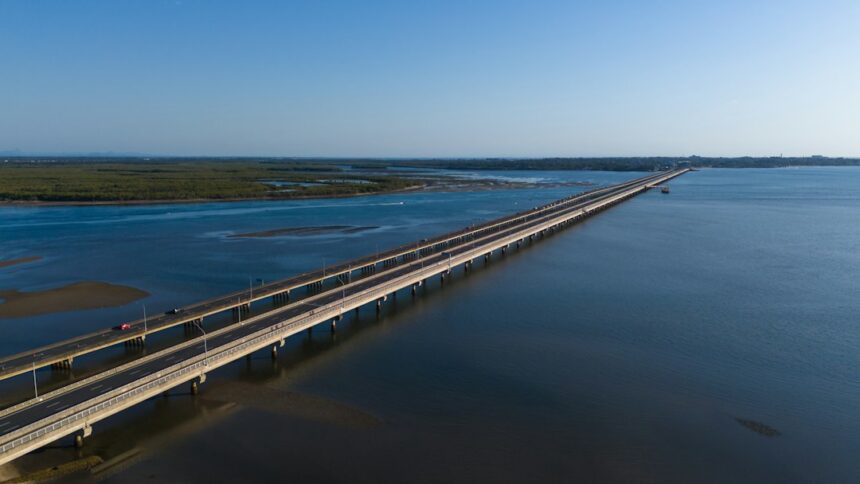
At the Fitzroy River, piling has started at the Pink Lily riverbank for a new 435-metre bridge linking Pink Lily and Parkhurst. A temporary work platform is also advancing across the river to support the movement of machinery, materials and bridge components.
At the Capricorn Highway connector, crews have now installed all 150 girders required for the 841-metre bridge. Each girder is about 34 metres long and weighs approximately 84 tonnes.
Precast production is becoming a local workstream
In North Rockhampton, construction of the Werribee Street precast yard shed and installation of gantry cranes have also been completed ahead of commissioning planned for October.
The purpose-built facility will manufacture 312 concrete segments for the new Fitzroy River bridge, creating a local production workstream tied directly to the project rather than relying entirely on components from outside the region.
For suppliers, that matters because large road projects distribute spending across more than the headline civil contract. Precast concrete, reinforcement, transport, cranes, plant hire, traffic management, quarry materials, testing, environmental services and workforce support can all form part of the project ecosystem.
A freight project as much as a bypass
The Ring Road is intended to create a western bypass of Rockhampton for through traffic on the Bruce Highway. Its economic case is closely linked to freight reliability as well as urban congestion.
Central Queensland’s mining, agriculture, energy and industrial sectors depend heavily on north-south road freight. Removing more heavy vehicles from central Rockhampton and improving resilience around flood-prone sections of the network can reduce travel-time variability for operators moving goods through the region.
The project is also being positioned as part of the infrastructure platform supporting Rockhampton’s role in the 2032 Olympic and Paralympic Games, with rowing confirmed for the city.
Construction risk shifts to delivery
As the project advances, the key questions increasingly move from mobilisation to delivery: sequencing major structures, managing river works, maintaining traffic flows, coordinating local production and keeping the wider program on schedule.
The latest milestones show multiple construction fronts operating simultaneously, a sign that the project is moving into a more capital- and labour-intensive phase.
For Central Queensland contractors and suppliers, that should keep procurement opportunities flowing across civil works, concrete, logistics, equipment, services and maintenance as the Ring Road progresses.
Source: Australian Government Department of Infrastructure, 18 September 2026.
Featured image: Benny Hassum / Unsplash.