
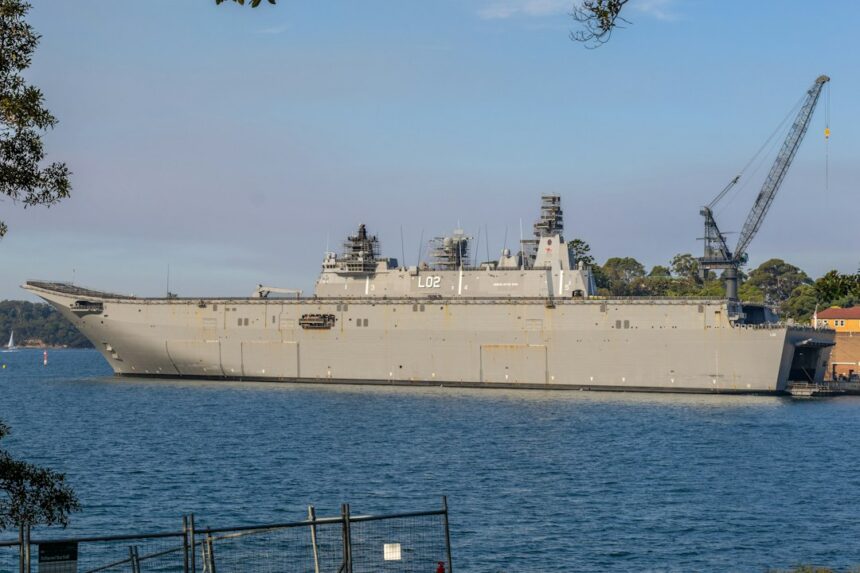
BAE Systems Australia has secured a five-year, $32 million Commonwealth contract to sustain the Mk 45 naval gun systems fitted to the Royal Australian Navy’s Hobart-class destroyers and Anzac-class frigates.
The contract, announced on 17 September, covers preventative, corrective and priority maintenance across the Navy’s Mk 45 systems. It also includes refurbishment work as the Hobart-class destroyers move through their Destroyer Capability Enhancement program.
HMAS Hobart’s gun is already being refurbished at the Osborne Naval Shipyard in South Australia, linking the sustainment work directly to the broader upgrade cycle for one of Australia’s principal surface-combatant classes.
Sustainment work extends beyond a single fleet
The Mk 45 is a 127mm naval gun used for surface warfare, naval gunfire support and other shipboard missions. It has been operated by the Royal Australian Navy for decades and remains relevant to the future fleet because the system is also planned for Australia’s Hunter-class frigates.
That gives the sustainment contract a longer strategic tail than its five-year term might suggest. Skills, spares, maintenance systems and engineering knowledge retained through the current Anzac and Hobart fleets can support the transition into new platforms as they enter service.
For Australian defence industry, sustainment contracts are an important part of the procurement landscape because they provide recurring workload after the initial acquisition of a platform or weapon system. They also tend to create opportunities across engineering services, component supply, maintenance, logistics and specialist technical support.
Osborne remains central to naval industrial activity
The refurbishment element reinforces the role of South Australia’s Osborne precinct in the Navy’s surface-fleet program. The shipyard is already a focal point for major naval construction and upgrade activity, and the Destroyer Capability Enhancement program adds another layer of work to the precinct.
BAE Systems Australia’s surface-ships business said the new contract would allow it to continue supporting frontline Hobart-class destroyers and Anzac-class frigates while maintaining the skills required for future fleet needs.
The commercial value is modest compared with Australia’s largest shipbuilding programs, but the contract illustrates how defence spending flows through a long lifecycle. Major platforms generate procurement opportunities not only when they are built, but through decades of maintenance, upgrades, capability enhancements and eventual transition.
A wider supplier opportunity
For smaller Australian suppliers, the opportunity sits around the prime contractor. Sustainment programs can require machining, fabrication, inspection, logistics, technical documentation, specialist engineering and parts support, often with higher continuity than one-off construction packages.
The Mk 45 work also arrives as defence procurement increasingly emphasises sovereign industrial capability and supply-chain resilience. The extent to which primes translate large Commonwealth contracts into sustained local supplier work remains an important measure of the broader industry benefit.
With the Hunter-class frigates expected to use the same gun family, the latest award also positions the current sustainment base as part of a continuing naval capability rather than a legacy-only program.
Sources: BAE Systems Australia, 17 September 2026; Australian Defence industry reporting, 17 September 2026.